Tuesday, May 28, 2013

The "F" Word

Why is it that women get mixed messages about whom they should be?

We are going to be watching a film called The "F" Word.
No...the "F" word is not the four letter one.  This one has eight letters.  Feminism.

Before you watch this film, what do you think feminism means?  Are you a feminist?


After watching the film, answer the same questions.


Make a list of reasons why someone might choose to call themselves a feminist.

What are some of the disparities between men and women?

Using a Venn Diagram, compare the following:

  1. What basic rights DO men and women have? 
  2. What basic rights SHOULD men and women have?
  3. What expectations are on men and/or women?
  4. What issues are specific to men/women?
  5. What issues are common to men and women?
  Now that you have looked at these questions, write a blog entry that examines this question:
How are women's issues also men's issues?

WatchJackson Katz: Violence against women—it's a men's issue

Finding Dawn

Lorraine and Dawn Crey


We will be watching the movie "Finding Dawn".  As you watch this film, I want you to consider the following issues:
  1. Systemic racism - how is the inherent racism in the justice system demonstrated in the story of Dawn Crey?
  2. How did Dawn suffer from a loss of identity and how did this affect her?
  3. What made the missing women of the downtown eastside nameless and faceless?
  4. Can you see a difference how the women on the Highway of Tears and the women of the downtown eastside are viewed?  How was the response of the community different?  Why might that be?
  5. "Women's issues are men's issues too."  We have already discussed this in class. How is this statement demonstrated in this film?

Read two of the following articles:
  1. Stolen Sisters
  2. Seeking Justice for Canada's 500 Missing Native Women.   
  3. Investigating Violence Against Aboriginal Women
  4. Vancouver Eastside Missing Women
  5. Racism Keeps Native Women's Killer Anonymous 
  6.  Police had enough to get a warrant for Pickton in 1998.

  7. Police blasted at Missing Women inquiry for failures to catch killer sooner 

  8. Racist attitudes hampered work on Pickton file


    Write a one paragraph response in your blog to these articles.

      Thursday, May 2, 2013

      United Nations Declaration of Indigenous Rights

      http://www.afn.ca/uploads/files/07-12-4_un_declaration_flyer_fe.pdf
      http://www.unicef.org/policyanalysis/rights/files/HRBAP_UN_Rights_Indig_Peoples.pdf

      June 11, 2008, Prime Minister Stephen Harper apologized on behalf of the government for the treatment of Aboriginal people who had been in residential schools.

      Aboriginal People and the Justice System

      Less than 3% of the population of Canada is Aboriginal, yet about 40% of the population of Canada’s prisons is Aboriginal.  What do you think might be the cause of this?


      Make a list of five things that you think might be factors in the over-representation of Aboriginal people in Canada's prisons.

      1.

      2.

      3.

      4.

      5.


      Notice how all these factors hold the person in a web of poor choices.  

      Traditional Aboriginal justice varied from nation to nation, however there were some common themes.  What are the common themes and the different practices in traditional Aboriginal justice?  What is the basic philosophy of Aboriginal justice compared to the Canadian justice system?


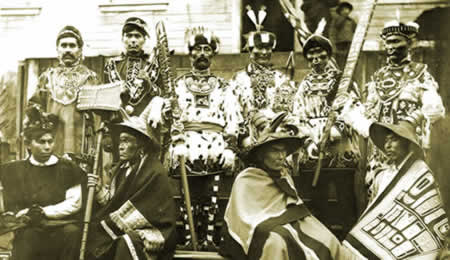
      Aboriginal people have faced a justice system that has racism embedded in it for many, many years.  Aboriginal people did not have equal rights in the law to other Canadians.  They were not allowed to hire lawyers to settle land claims.  Traditional ceremonies like the potlatch were made illegal.  On the prairies, First Nations people would have to get permission (and a card) from their Indian agent if they wanted to travel from their reserve to a different reserve. The pass-card said where the person could travel to, and how long they could stay. The Canadian government didn’t want different reserves to organize and either make demands or war against them. It was also illegal under the Indian Act for an Aboriginal person to have any alcohol. Aboriginal people who did not speak English or French were not given translators. An Aboriginal person who only spoke their traditional language could end up in court, but not understand what was being said. Obtaining a fair trial was impossible. 


      Today, the numbers of Aboriginal prisoners is a serious problem - 40% of all prisoners in federal and provincial prisons are Aboriginal. 

      Racism aside, many of these prisoners suffer from personal histories that have thrown them into the circle you looked at above. 

      Problems experienced as youth
      % of FN prisoners
      Parental neglect
      39.1%
      Absent parent(s)
      35.9%
      Group/foster homes
      10.9%
      Runaway
      9.4%
      Poverty
      35.9%
      Alcohol Abuse
      84.4%
      Drug use
      50%
      Learning problems
      15.6%
      Behavioural problems
      65.5%
      Emotional problems
      21.9%
      Physical abuse
      50%
      Sexual abuse
      21.9%

      Highest grade achieved
      Percentage of FN prisoners.
      Grade 6 or less
      12.5%
      Grades 7-9
      46.9%
      Grades 10-12
      37.5%
      Post graduate
      3.1%

      Vocational Skills
      Percentage of FN prisoners
      No Response
      7.8%
      Unskilled
      45.3%
      Semi-Skilled
      23.4%
      Skilled (Non-traditional skills)
      18.8%
      Craftwork/Artwork
      4.7%


      Needs of Aboriginal Inmates
      Percentage of FN Prisoners
      Substance Abuse Treatment
      88%
      Personal/Emotional Counselling
      82%
      Employment Counselling
      63%
      Education and Training
      54%


      Other causes of higher arrest rates are:

      • Police arresting without cause.
      • Police are more likely to patrol areas of cities that have a higher Aboriginal population.
      • These areas have higher poverty levels, other social problems, and  higher crime rates
      • This results in Aboriginal peoples being arrested for minor offences that would be overlooked in the white community.   Fewer non-Aboriginal people are arrested for the same offence because there are fewer police in their area.
      •  There is also evidence that police are less likely to arrest a non-Aboriginal for being drunk in a public place than an Aboriginal person.
      • There can also be different community standards for behaviour in cities and towns compared to reserves. Reserves are smaller and are more tightknit.  Behaviour that is criminal off reserve might not be considered criminal on reserve – it is seen as being part of who that person is. Being arrested in a city usually results in the accused being dealt with through the formal, legal justice system.
      Reforming Canada's Prisons:  

      In groups, discuss these questions.


      • What is the purpose of prison?
      • Is it to punish the offender, or is it to rehabilitate the offender?
      • Is prison always the answer to criminal activity? 
      • Is the incarceration of offenders always the best option?


      Sentencing Circles: Sentencing circles are one way that the prison system is trying to make things better for Aboriginal offenders.


      In a sentencing circle, the aboriginal community decides a person’s punishment. Also the offender is expected to make amends not just to their victim but to the community. This is called restorative justice.


      Restorative justice doesn't work for everyone or every situation.  In a group, create a list of criteria that an offender would have to meet before they can take part in restorative justice.


      …the [current] system is right now just a punishing system…They’re not looking at what’s causing these problems, they’re looking at, hey, we have to punish this guy for what he’s done…a lot of these guys go to jail, and they sit around this ten-by-twelve cell…And they get very bitter. …Here in a sentencing circle, we make sure somebody tells the offender that we’re here to help, for support…if recommendations are made that he takes some kind of programming to better himself back in society, he’s not only promising the magistrate or probation officer, he’s promising it to his own community.

      Restorative justice and sentencing circles can allow offenders to begin to heal.

      Criticisms of Sentencing Circles:


      What do you think might be some of the criticisms of sentencing circles?


      How do you think this fits into the concept of social justice?


      ***Since first posting this, Harper's Conservative government has put forward the "Safe Streets and Communities Crime Bill" which demands minimum sentencing for crimes involving violence, sex abuse and terrorism.  Critics of this bill believe that it will derail the restorative justice process as it will not allow judges to choose what sentencing process is best for the situation.  

      Crime bill will put more behind bars, critics say

      Tough-on-crime bill will hurt First Nations, says Atleo


      Tuesday, April 30, 2013

      LGBTQ Wrap Up

      We will be watching the film Breakfast with Scot.  After the film you will be asked to consider the following things:


      1. What examples of homophobia do you see in this film?
      2. Why does Eric feel so unable to 'come out'?
      3. Compare the gender expression of Scot and Eric.
      4. In what ways does Scot try to change his gender expression?
      5. What factors push Scot to feel he needs to change his gender expression?
      6. What are the effects of Scots attempts at changing his gender expression?
      7. What are the sexual orientations of the three main characters?


      You will also need to know the following terms:
      1. gay bashing
      2. trans bashing
      3. gender binary
      4. gender expression
      5. gender identity
      6. heterocentrism
      7. heteronormativity
      8. homophobia
      9. transphobia
      10. lesbian
      11. gay
      12. bisexual
      13. transgender
      14. transqueer
      15. cisgender
      16. pansexual
      17. intersex
      18. asexual
      19. ally
      20. queer
      21. questioning
      22. two spirit

      Finally, on Friday I am going to ask you to do a little research on one of the following people or issues:
      1. Bill Siksay
      2. Joan Baez
      3. Josephine Baker
      4. Irshad Manji
      5. Long John Baldry
      6. Drew Barrymore
      7. Cyrano de Bergerac
      8. Arsham Parsi
      9. Trevor Boris
      10. David Bowie
      11. Marlon Brando
      12. Franco Grillini
      13. Anita Bryant
      14. Truman Capote
      15. Same sex marriage
      16. Giacomo Casanova
      17. Virgilio Barco Isakson
      18. Christine Burns
      19. Margaret Cho
      20. Jason Collins
      21. Mark Tewsbury
      22. Libby Davies
      23. Don't Ask Don't Tell
      24. Harvey Milk
      25. Dan White
      26. Greg Louganis
      27. Sven Robinson
      28. Luiz Mott
      29. Vito Russo
      30. John Amaechi
      31. Margaret Thatcher
      32. Matthew Shepard
      33. Brendan Burke
      34. Stonewall (event)
      35. Stonewall (charity)
      36. Ian McKellan
      37. Jane Rule
      38. Chaz Bono
      39. Martina Navratilova
      40. David Kato Kisule

      Tuesday, April 16, 2013

      Gender and Sexuality


      Gender Identity, Gender Expression, Sexual & Romantic Orientation/Attraction and Biological Sex/Body Presentation and Sexual Behaviour are five completely individual and separate aspects to a person’s life.   We are all made up of a mixture of the five and there are as many variations as there are people.


      As a heteronormative society, we tend to think of people as either male or female, gay or straight, masculine or feminine but this kind of gender-binary thinking does not represent the actuality of human gender and sexuality.  Look at the following people.  How would you describe their gender expression?


      Can you tell what body presentation/biological sex each of the following people were born with?

      Nadya Sulemon - Mom

      Svend Robinson - politician

      Sarah Gronert - tennis player


      Isis - model

      Gwen Araujo - high school student
      Chas Bono - celebrity
      Davin Sokup - university student


      In groups, create some kind of model that shows the wide spectrum of:
      1. Gender Identity, 
      2. Gender Expression, 
      3. Sexual Orientation/Attraction and 
      4. Biological Sex/Body Presentation

      Why Look At LGBTQ Issues?

      Why do you think the Ministry of Education included a unit on gay rights in Social Justice 12? 


      Letter from Rev. Jerry Falwell 

      "I refuse to stop speaking out against the sin of

      homosexuality with God as my witness. I pledge that I'll 

      continue to expose the sin of homosexuality to the 

      people of this nation. I believe that the massive 

      homosexual revolution is always a symptom of a nation 

      coming under the judgement of God... Recently 250,000 

      homosexuals marched in the streets of San Francisco. 

      Several weeks ago 75,000 more were marching in the 

      streets of Los Angeles. Homosexuals are on the march 

      in this country. Please remember, that homosexuals do 

      not reproduce, they recruit, and many of them are after 

      my children; your children...Let me repeat. A massive 

      homosexual revolution can bring the judgement of God 

      upon this nation. Our children must not be recruited to a 

      profane lifestyle."


      Watch these clips:

      The Worst Place in the World to Be Gay: Part One, Part Two, Part Three, Part Four


      Do you know these names or expressions?  Harvey Milk, Anita Bryant, Matthew Shepard, Sven Robinson, Vito Russo, Don't Ask Don't Tell, Prop 8, Pink Triangle, Stonewall.


      There are some words that you need to know when you are talking about LGBT issues.  The following letters some people call the "Gay Alphabet".

      L
      G
      B
      T
      T
      C
      P
      I
      A
      A
      Q
      Q


      and a separate T


      Can you figure out what each of these letters stand for? What does each word mean?

      Some other vocabulary you should know includes:
      • gay bashing
      • gender-binary
      • gender identity
      • gender queer
      • heterocentrism
      • heterosexism
      • heteronormativity
      • homophobia
      • sexual orientation
      • trans bashing
      • transphobia
      • two spirit